


Oakland port sees stable July despite import dip
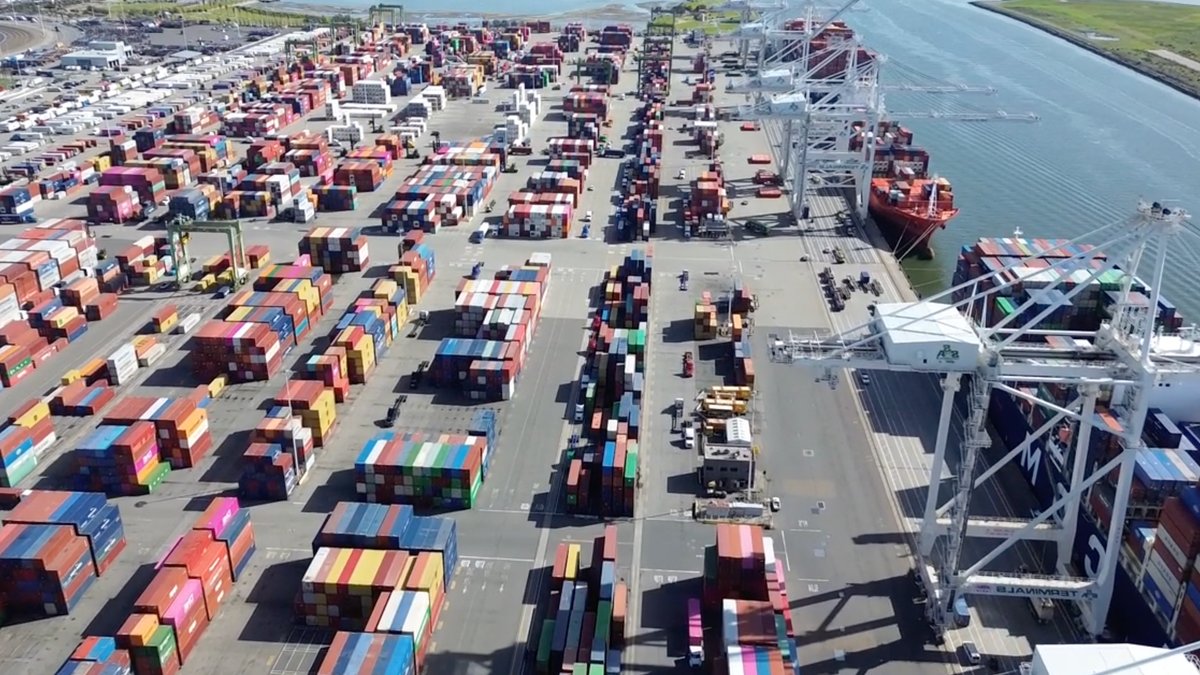
The Port of Oakland handled nearly the same number of shipping containers in July as it did in June, but the month still marked an 11.4% drop compared to the same period last year.
In July, the port moved 179,999 twenty-foot equivalent units (TEUs), a figure almost identical to June’s total. Year-over-year, however, the decline was clear: full imports fell 14% to 79,426 TEUs, while full exports dropped 8.5% to 60,005 TEUs. Laden cargo—containers carrying actual goods—declined 11.7% to 139,431 TEUs.
Imports and exports show mixed trends
Month-to-month, full imports rose slightly by 1.7%, but full exports fell 7.9%. Empty containers, often repositioned to balance global trade flows, totaled 40,568 TEUs, down 10.2% from July 2025.
Related: Deputies recover 123000 in stolen Brooks shoes
For the first seven months of 2026, Oakland’s total container volume reached 1,294,664 TEUs, a 3.8% decline from the same period last year. The drop was driven largely by a sharp 11.4% reduction in empty-container movements. Laden cargo, however, dipped only 1.5%, with full exports actually up 0.4% year-to-date. Full imports, meanwhile, fell 3.1%.
Jason Garben, the port’s acting maritime director, called July a “challenging month” but noted that laden volumes remained “essentially flat” for the year. “Despite uncertainty in the market, we are hearing a positive outlook from our ocean carrier partners for the remainder of the year,” he said.
Vessel calls decline as carriers adjust routes
The port recorded 81 vessel calls in July, down from 95 during the same month in 2025. The reduction aligned with the overall drop in container volume, though some carriers have recently resumed service.
This week, Hapag-Lloyd’s Missouri Express became the first ship to call at Oakland as part of the WC5 U.S.-flag service, signaling a partial rebound in scheduled routes. The service had been suspended earlier in the year as carriers rerouted vessels to avoid congestion and cost pressures.
Related: Evan Buie Joins Global Affairs Canada
The port’s relative stability in laden cargo suggests that while overall trade volumes are softening, the flow of actual goods remains resilient. Still, the decline in empty containers—often a leading indicator of future demand—points to lingering caution among shippers. If carrier optimism holds, the second half of the year could see a modest recovery, though any rebound will likely depend on broader economic conditions and consumer demand.
Through July, the port’s performance reflects a cautious but not collapsing market. The slight year-to-date increase in exports, even as imports decline, hints at shifting trade patterns—possibly driven by regional manufacturing shifts or changes in global sourcing strategies. Whether these trends hold will become clearer in the coming months, as peak shipping season approaches.
Garben’s comments about carrier optimism may offer some reassurance, but the port’s numbers tell a more subtle story: steady on the surface, but with underlying pressures that could reshape its role in trans-Pacific trade.


